Saturday, January 19, 2019
Sunday, January 13, 2019
Days 9-10: Penguins!!!
Update:
Another full day in the beautiful city of Dunedin! Day 9 has been my favorite of the entire trip thus far. We slept in late and woke to a sunny, breezy day. We decided to head to the octagon for some gourmet waffles. Mine had strawberry sauce drizzled over top some fresh raspberries, boysenberries, and kiwi fruit.
We walked around the city for a while and headed back to the bus. It took us down the Otago Peninsula, where we had three of the most exciting tours scheduled. First we walked through a yellow-eyed penguin hospital, where many of the patients were underweight for their molt or had too many feathers missing to swim successfully. The chicks were clumsy little fluff balls, and their little hops to get up on a rock was the most adorable thing to watch! The adults were happily splashing around their little pool and honking at us. After looking into the enclosures, our guides, Lou and Ra, headed down the brush the area overlooking a beach. The beach is protected and potentially the only one in the area without human footprints. This is to help protect the habitat of the endangered birds. Wild yellow-eyed penguins are nocturnal and therefore unpredictable in the daytime. Our guides could not promise we would spot one, and unfortunately we did not. We did still spot some wildlife: a tiny two-day old blue penguin chick! The camera shutter was too loud and its nesting box too dark for me to take a picture without disturbing the chick, so I sadly do not have a picture of it. I do, however, have many pictures of seals! They were everywhere, sunning themselves on the rocks and loving life. They were adorable!
After our penguin tour, we headed to the Royal Albatross Center to look at another species of bird. Unlike the penguins, albatross can fly and have wingspans of up to 3 meters! They lay eggs every two years, spend a year hatching and nurturing the fledgling, then on their very first flight they spend five years flying towards South America. They sleep by floating on the ocean, and spend up to 36 hours just sailing on the ocean winds. We saw many of these majestic birds on top of a little hill, then quickly went through a military fort. It is one of four British-built strongholds on New Zealand, but there were never any threats requiring use of the forts.
We stopped at a pub for some really good seafood chowder and fancy mochas for dinner. Since our third and final tour was not until sunset, we killed time by tossing a frisbee on a beach. Then came the highlight of my day: watching the little blue penguins return to shore! Blue penguins leave one parent at home on the shore to watch the egg, or leave an older chick by its own, and spend all day fishing. They return with food and have sunset family reunions! They are only 25 centimeters tall and have blue backs with white fronts. Seeing this wild animals in their natural habitat, instead of in a zoo, is a memorable experience I'm so glad this trip provided me with!
The next day was spend driving to Wanaka. We drove through the land used for filming Rohan from Lord of the Rings, and also stopped at the Pillars of the Kings and the Anduin River fords (outside of Rivendell). Another fantastic stop was a fresh fruit stand! They make fresh fruit ice cream and have some amazing cherries, white peaches, and mandarins. After this one night in Wanaka, we will be staying in the backcountry for four nights without internet. This is Mahu Whenua, our wildlife conservation project! I am so excited for it!
The Best and Worst of New Zealand (So Far):
Like I said above, my favorite place so far was the penguin colony. I already adored these funky little creatures, but seeing them in their natural habitat was really eye-opening for me. Their funny little hops and waddles are really their only way to move, and as comic as they are, it can really put them in danger from predators. They are smart in using the cover of darkness and camouflage to survive, and I have a new appreciation for these smartly-dressed birds. I really hope the protected colonies are successful in revitalizing the penguin population. The beaches and Otago peninsula surrounding the colony only help my raving review of the place; with gentle ocean waves on one side and lofty mountains on the other, you can't go wrong no matter which window you look out of!
My least favorite place was Auckland. We only experienced the airport, to be fair, and spent most of the time in customs only to miss our flight. As far as places we've actually spent time in, however, my least favorite place thus far was Wellington. I enjoyed the city, but compared to all the other beautiful landscapes we've seen, it's not as breathtaking as I initially thought. It is a good way to ease into the nature of New Zealand, and probably kept my dulled American senses from being overwhelmed by picture-perfect scenery. We also spent the least amount of time in the actual city itself. Since it was the most commercial and least nature-focused (not counting our Zealandia excursion, since I consider that the cable car took us outside of Wellington), it was the lowest ranking place on my list. However, I still love all of New Zealand and this trip and would happily take another chance to come here, even only to Wellington!
Friday, January 11, 2019
Days 7-8: Dunedin
Update:
On a grey, cold morning, we left Christchurch and drove on the bus for hours. The first stopping point of interest for this day was the Moeraki Boulders, which were formed into natural spheres by the constant wave motion. After half an hour of climbing the rocks, we got back on the bus and continued to Dunedin.
The city of Dunedin is precariously spread out over and among a series of hills. It was planned by the Scots, who in a burst of foresight, decided not look at a map of the landscape before deciding where to place their streets. The result was Baldwin Street, a residential drive that is in the Guinness Book of World Records for being the steepest street in the world. It certainly was a difficult hike up! After reaching the summit and befriending a stray chicken up there, we carefully descended and headed to our hostel. We will be staying at the Kiwi's Nest, an adorable little abode that will house us for three nights. It is conveniently located right across the street from an ice cream shop, and a short 7 minute walk to downtown. Their central downtown "square" is actually an octagon. It contains an excellent authentic Mexican restaurant, and many other places I look forward to eating at later!
Our first full day in Dunedin started later than our previous days, luckily for me. After a leisurely breakfast at 9 am, we left for the University of Otago. This college focuses primarily on sciences (convenient for me if I wanted to transfer! Hypothetically, of course). We met with two representatives from the zoology department, Christoph and Janice. They are both professors and are both involved with Mahu Whenua.
Mahu Whenua (pronouned MA-hoo FEN-oo-wa) is a QE2 (Queen Elizabeth II) trust, which means it is a private conservation effort that is protected forever. Numerous people have been a part of surveying this land and using it for ecological research, including the University of Otago. Originally, the land was split up into four different farms; each farm was purchased at a different time by music industry giant Mutt Lange and his then-wife, Shania Twain. They then converted the land to QE2 and handed it over to scientists who wanted to explore and survey it. We will be spending multiple days in the backcountry of Mahu Whenua, helping their conservation efforts along and contributing to this enormous project. We are investigating the effects of invasive species and cataloging the different types of flora we find. The representatives from the University of Otago will be accompanying us, and they were kind enough to give us very informative presentations about the work we will be doing.
We left this beautiful campus and headed to even more beautiful landscape: the ecosanctuary of Orokonui. Being in the South Island, this ecosanctuary is a bit colder than Zealandia or Kaipupu. It has similar bird species, but they sing in different dialects. It houses very few kiwi; however, my goal on this trip is to someday spot this elusive bird! We had a wonderful guide, Sue, who was knowledgable about every type of bird, skink, and plant that we came across. We saw a very round takahe, multiple bellbirds, and kakas. The birds were incredibly loud! The forest smelled like lemonwood, like a cross between citrus and eucalyptus. We tasted pepper tree leaves, which were spicy like chili peppers. There were also fuchsia berries, reminiscent of watered down blueberries. The denser part of the forest we went into just felt ancient. The damp ferns and lancewoods came right out of a Jurassic Park movie, but the diversity of life packed into this place created a powerful feeling.
Ethics of Orokonui
Orokonui serves as a safe haven for many endangered species. This includes flightless birds and reptiles that do not have the evolutionary ability to defend themselves from predators. New Zealand's only non-aquatic mammal is the bat, and all others have been introduced by people. In order to protect these endangered prey, there are fences and traps all around Oronokui to keep all predators out. However, when stoats, possums, and even cats become trapped, they are killed by the people running the traps. The predators are only killed if they enter the sanctuary.
Orokonui is a magical place, and it is saving many endangered species. However, I am extremely torn on this stance. They value the lives of some animals over others with severe consequences. The predators are only acting on their instincts to feed themselves. While these animals are not endangered, the ecosanctuary trapped and killed 500 cats last year. Killing predators at such massive numbers is comparable to massacres. The protected birds are only protected for human enjoyment, since their role in the ecosystem as food is negated by their preserved status.
I acknowledge the fact that without these protective measures in place, these birds may be endangered or even become extinct, which is a tragedy within itself. Humans introduced the problem of invasive, predatory mammals, and it is up to humans to fix this ecological imbalance. But since the predators have been living in New Zealand for so many years, they have established a rightful place in the ecosystem. I too come from a biased place of valuing the lives of some animals over others, as I am more upset about the killing of cats than the weasels or possums, but I still think there is a better option for all trapped animals. Spaying or neutering the trapped predators prevents their uncontrollable breeding, which should help protect the prey. Deporting or removing them to a different part of the country is a more humane way of keeping predators out.
Wednesday, January 9, 2019
Days 5-6: Christchurch!
Update:
We had one full day at Kaikoura while still staying at the Marae. After breakfast, a man came to talk t us about the archaeological history of the Maori. He brought some old tools used for carving and fighting, as well as Moa bones. Moas were basically ostrich-sized Kiwis who were hunted to extinction by Maori tribes. Since they were eaten and the bones discarded in swamps, their remains were preserved until today. I got to hold a toe bone, and it was about the size of my palm!
The rest of the day was a free day for us. We used this opportunity to explore some tide pools nearby. It was a fun time; we probably climbed all along the shore for about two hours. I saw a couple starfish, an octopus, a crab, some massive sea slugs, and some live Paua! After our beach adventures, a smaller group of us walked to downtown Kaikoura. It is a small oceanside town, similar to Picton, but maybe a touch smaller. It was mostly full of coffee shops and boutiques, which made it a great place to pick up some souvenirs! New Zealand is famous for its green stone, which are similar to jade. Most of it is sourced from the west coast of the South Island, and it has a special meaning in Maori culture. I was lucky enough to get a greenstone necklace and ring!
After stopping for lunch (and ice cream), we headed back to the Marae to work on some assignments for our classes. We had a wonderful dinner that Emily and Allie, two of our students, prepared: butter and garlic steamed mussels, fresh caught fish, ratatouille, and pavlova!
The next morning, we left Kaikoura and traveled to the city of Christchurch. The bus wound through the mountains and eventually led us to an overlook called Sign of the Takahe. A takahe is yet another indigenous flightless bird of New Zealand. We got some great shots of the city from a distance! Once we arrived, we stopped at our hostel then underwent a walking tour. Ian led us through parks, the Bridge of Remembrance, a circus, and much more. We also saw the Cardboard Cathedral, which was built of cardboard and wood to more sustainably replace the destroyed Cathedral Square.
After walking for a bit, we stopped for more souvenir shopping and ate dinner at a burger cart. We watched the sunset, and one of our group played basketball with the locals while we cheered him on and climbed around the park. The city of Christchurch is astoundingly photogenic and clean, and I wish we could spend more time here!
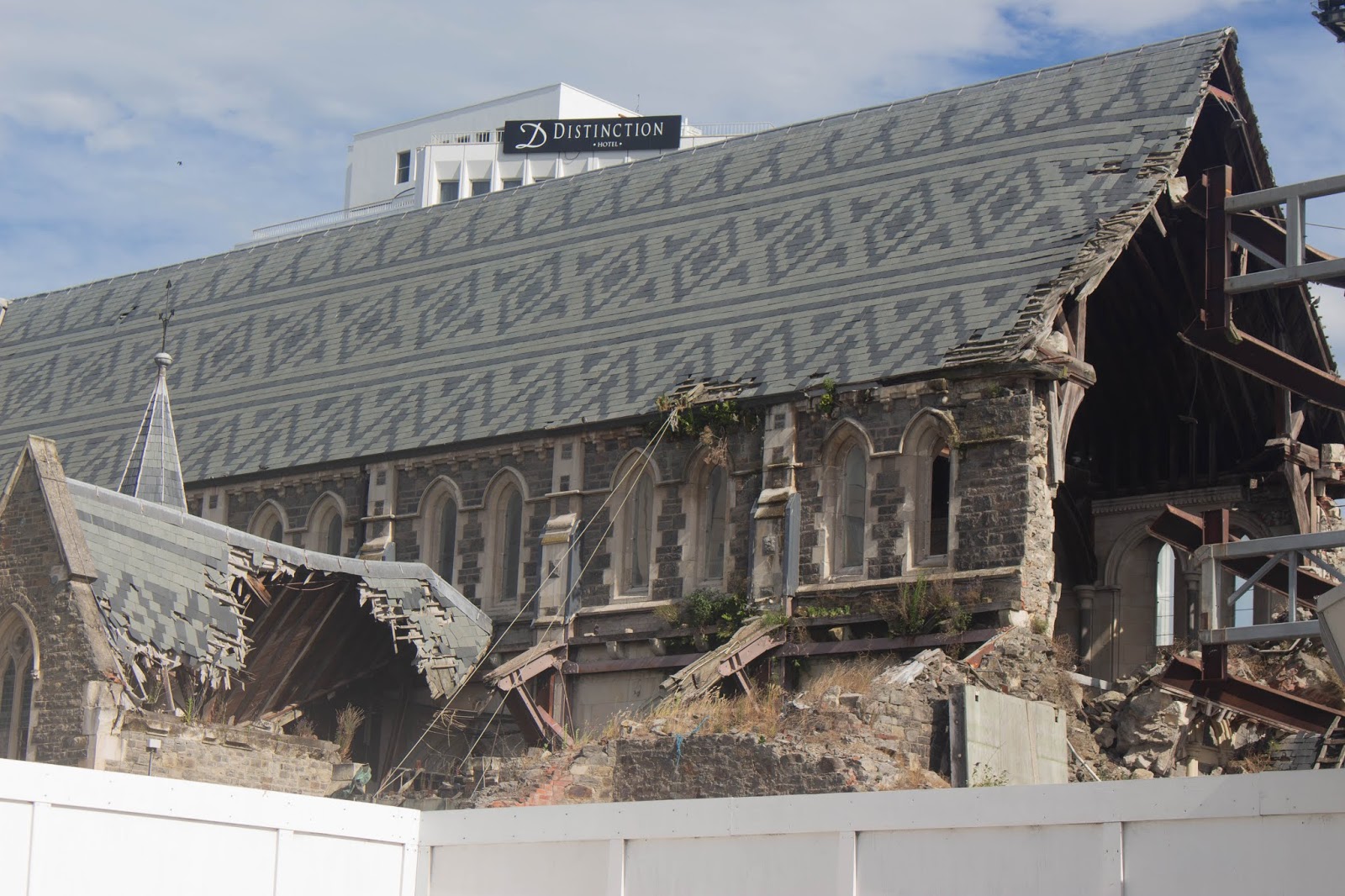
Christchurch Cathedral
We saw Cathedral Square, which is the central part of Christchurch. In 2011, the city experienced a devastating 6.2 magnitude earthquake that killed 185 people. Most of the damage was centered in this cathedral, which has been left as a monument to those who were killed. There is some debate as to what should be done with the Christchurch cathedral; should it remain in its damaged state, should it be torn down and rebuilt entirely, or should it be restored to how it was before the earthquake?
In my personal opinion, the cathedral should be rebuilt to how it was before the earthquake. Restoring it to its former glory respectfully honors those who died in that church, and putting a plaque on the outside or inside further remembers the dead. There is already a monument to them, rows and rows of painted white chairs that uniquely represent each individual that died. The combination of the white chair installment and a restored cathedral pays homage to each victim.
Monday, January 7, 2019
Days 3-4: Liminal Spaces
Update:
We were all very sad to leave Wellington on the third morning. We boarded the Interislander ferry and endured a three hour thirty minute ferry ride to the South Island. The view was pretty from the harbor of Wellington, but arriving at Picton was definitely the most exciting part of the entire trip. Once in Picton, we met our bus driver, Pania, who will be accompanying us for the remainder of our study abroad.
Picton is an adorable little town full of coffee shops, boutiques, ice cream stands, and even more breath-taking ocean views. Our first item on the itinerary was sea kayaking. We were headed to Kaipupu, a wildlife sanctuary blocked off from the mainland so only kayakers could reach it. Our kayak guides, Merlin and Chris, lead us up a steep twenty minute hike (they claimed it was a "short walk, not steep or a hike at all" and they lied!). The lookout on the top was totally worth the effort! The sea was blue, the sun warm and yellow, the breeze fresh and clean... I definitely wouldn't mind living near here either! As we walked back down to our kayaks, we passed multiple nesting boxes for penguins! They were unfortunately empty, but New Zealand penguin chicks actually head back to their old nesting boxes and kick out their parents. Penguins in the box have to compete for the space with their mature offspring and kiwis, who also try to claim the safety of the boxes. We also tried three different types of plants on our descent: kawakawa, which is used to make tea; a vine that tasted like watery green beans; and another leaf that made our mouths go numb, which the Maori used as painkiller for dressing wounds.
After the arduous descent, we jumped into the ocean for a nice cool-off, then returned back to the mainland. We headed to our hostel, which looked more like a bed and breakfast than a youth hostel. We found dinner at an excellent little fish and chips shop, ate ice cream on the beach, and watched the sunset.
The next day, we unfortunately left the town of Picton. We had the most delicious hot pies for breakfast from the Bakkerij next door, who are a world-famous bakery, and rightfully so! We boarded the bus and drove along the coast for about an hour. We stopped at Pelorus Bridge for lunch and built little rock sculptures along the river. Photographing our rock sculptures and bridges made for a really fun break from driving. Kim led an interesting discussion on liminal spaces, which are transitions between two significant states. We mark liminal times of our lives with ceremonies and physical markings, We ate lunch on the bus and continued along Highway 1. New Zealand has seals too! Our group took a scenic detour and climbed around rocks with a seal friend. Soon after, we arrived in Kaikoura.
The Marae
Kaikoura is another small seaside town, similar to Picton. We are staying on the Takahanga Marae, which is comparable to a Native American reservation for a Maori tribe. The Maori have been on this land for hundreds of years, and it is a registered preserved historical site. The New Zealand government works much more closely with Maori people to respect their culture using legislature, and Maori is one of the national languages of New Zealand. These people have such an interesting history, and we were lucky enough to experience their welcoming ceremony.
For the ceremony, a mature or older woman (Kim, for our group) lead the pack with the younger women in age order behind her. Ian led the men, also in age order. In the olden times, the women would proceed the tribal procession to indicate that the newcomers were not coming for war. The warriors, or the young men, were in the back and could not fight from the distance. We entered through a tunnel made of whale bone and walked up the swirl-patterned path to the Wharenui, the sacred meetinghouse where we'd be sleeping for two nights. It is forbidden to wear shoes inside the Wharenui. We sat with the men on the front row, our BGSU group facing the iwi (tribe) who would be welcoming us. They said some words in Maori, which is a very melodious and flowing language with few hard consonants or breaks between phrases. They did a chant/song to acknowledge us and the ancestry that we carry with us, then we stood and sang a song back to them (Ay Ziggy Zoomba, our fight song). They took us out of the Wharenui and shared food with us, completing the official welcome.
We explored the Marae a bit, and had a really cool conversation with a woman named Mari who went to a Maori school on the North Island. Due to cultural reasons, we are not allowed to take pictures of the Wharenui, but we were given permission to photograph the grounds. The sunset filtered through the flowers and the greenery, and it made me really happy New Zealand is currently in the midst of a gorgeous summer! There is also a beach nearby, peppered with a mix of grey and white stones. The ocean looks particularly blue grey here, and the colors are unlike the combination you'd find on an American beach.
My Biggest Impression
Takahanga is a wonderful place. The aspect that made the biggest impression on me, however, was the focus on connection. The Marae is built to foster a spiritual connection to one's ancestry and one's past, thus recording one's sense of self and one's culture in every notch of every carved wooden pillar. They also have such a strong connection to one another. They share life on this Marae, and that strengthens their iwi daily. Every thing has a deeper connection to something else, and their sculptures and landscapes honor every single connection.
Friday, January 4, 2019
Days 1-2: The Adventure Begins
Update:
Kia Ora everyone! After missing our initial connecting flight to Wellington and sitting around the Auckland airport, we finally reached our final destination. The beautiful sunshine and fresh air pretty much cured all my jet lag. The city of Wellington is beautiful! It is clean, quiet, and unlike any American capital city I've seen. Our first day was spent as a group at the beach, where we swam in the ocean and jumped off a peer. We had dinner at the Karaka Cafe and enjoyed some fresh seafood, as well as trying kawakawa tea (it's like a mix of spices, with ginger being the prominent flavor). After dinner, we slowly made our way back to the hostel along the waterfront.Day two was off to a much more energetic start than day one! New Zealand coffee is stronger than American coffee, but it doesn't have a very bitter taste. It still gave me the boost I needed to explore Wellington. We walked to a cable car, which took us up an incline and offered a superb view of the city. I tried to snap a few photos of the lighted tunnels and murals, but the car window was too dirty for my camera to focus well. I ended up with a great shot of Wellington from a distance, surrounded by the water. The cable car led us to Zealandia, which is (so far) my favorite place we've visited! It is a nature preserve filled with shags (large, black duck-like birds), tuataras (ancient lizards that look like bearded dragons, only much lazier), rare black robins, parrots, and more! The green trees and flowing water were perfect practice for someone not used to a camera (like me)! We hiked around for two hours, but I wish we could have spent more time. We even walked into an abandoned gold mine shaft, hoping to see some wetas. Wetas are basically enlarged crickets native to New Zealand. They look scary, but are actually quiet harmless (see one here).
After Zealandia, we grabbed lunch and ice cream from the food trucks along the waterfront. Next stop, Te Papa National Museum! It houses all of the national history and art of New Zealand, from Maori native culture to European colonization. It also had some pretty neat interactive exhibits, like a kaleidoscope you can make yourself and a room with colored lights you can change. We learnt a bit about Maori history since we will be staying on a Marae (comparable to a Native American reservation, but the Maori are much more prominent in New Zealand culture and government than America).
Ethics/Morality:
A large part of one of the classes I'm taking on this trip focus on the ethics and morality of environmentalism and conservation. The most admirable thing I noticed about Zealandia was its true commitment to preserving nature. They asked us to check our bags for stray seeds and plants to prevent the accidental introduction of invasive species. They have gates between the bird and tuatara areas to keep the predator/prey balance in check. However, they have such a strong opinion on conservation that they have a different balance between conservation and functionality that we do. They value their environment and stasis so much, that they drastically alter their way of life. There is even political talk of banning pet cats to preserve this balance. Outdoor cats hunt and kill many of New Zealand's flightless indigenous birds, which evolved without the presence of cats until Europeans brought them over on ships. These birds are already endangered without the introduction of cats, but pets like cats are practically a staple in human life. Shaping modern culture to conform to the environment is a different approach than American society takes to our conservational efforts, but at what point do we preserve to such an extent that we cannot enjoy what we have saved? Humans always will make an impact on the environment, and while we must protect the environment for future and value its resources, we cannot minimize that impact without minimizing humans themselves.
Te Papa had another admirable point of morality - they value Maori culture so much, that they are constantly giving pieces of their exhibits back to the tribes. For example, a Maori man had died, and according to his culture, he was to be buried with a valued piece of jade from a collection in Te Papa. The museum quickly and respectfully handed over the piece and never brought up the ownership. I think the level of respect that New Zealand shows to its native is astounding and should serve as a model in the US. The idea of "ownership" is more European than Maori, sent over with the colonial settlers. Respecting another culture to this extent made a huge impression on me, and I hope to carry that respect to our own experience on the Marae!
Subscribe to:
Comments (Atom)